Our main research focus is on organometallic and coordination chemistry of s- and f-block metals. Together with improving our fundamental understanding of these elements, we want to exploit their physicochemical properties to design new functional materials, and also to develop methodologies applicable to materials recycling and sustainable chemistry.
All our compounds are prepared using advanced Schlenk line and glovebox techniques. We then perform comprehensive characterisations of our compounds using a variety of spectroscopic and analytical techniques e.g. single crystal X-ray crystallography, multinuclear NMR, UV-vis-NIR spectroscopy, EPR, cyclic voltammetry.
We also collaborate with groups interested in the biological applications of metal complexes, helping with the design of new compounds and assisting with their physical characterisation and structural determination.
Mechanochemistry
The huge drive towards improving the sustainability of chemical manufacturing has inspired a lot of new research developments over the last three decades. One of the more recent developments is the use of mechanochemistry, i.e. the promotion of chemical reactions by mechanical energy – read more about it here.

By using mechanochemistry, it becomes possible to operate in the absence of solvents and access species that could not be made using standard solution methods. And this is exactly what we do in the Ortu Group, where we use mechanochemical methods to expand the chemistry of alkaline earth and lanthanide metals, focusing in particular on the study of the physicochemical properties of new materials and electrides.
Selected publications:
Mechanochemical Synthesis, Characterization and Reactivity of a Room Temperature Stable Calcium Electride: A.W.J. Bowles, J.A. Quirk, Y. Liu, G.H. Morritt, M. Freitag, G.F.S. Whitehead, A.W. Woodward, A. Brookfield, C.A.P. Goodwin, D. Collison, F. Tuna, C.L. McMullin, J.A. Dawson, E. Lu, F. Ortu, J. Am. Chem. Soc., 2024, 146, 28914, DOI:10.1021/jacs.4c09408.
Low oxidation state alkaline earth chemistry
The first example of low oxidation state Mg complex was reported by Jones in 2007 (learn more about it here). Since then, Mg(I) reagents have been used extensively as bespoke reducing agent for the activation of a variety of synthons (e.g. small molecules, unsaturated substrates) and for the formation of novel metal-metal bonds. However, this chemistry has not been extended to the heavier members of the family, with the exception of the serendipitous isolation of a Ca(I) inverse sandwich complex (read here) and the activation of dinitrogen by a transient Ca(I) complex (read here).
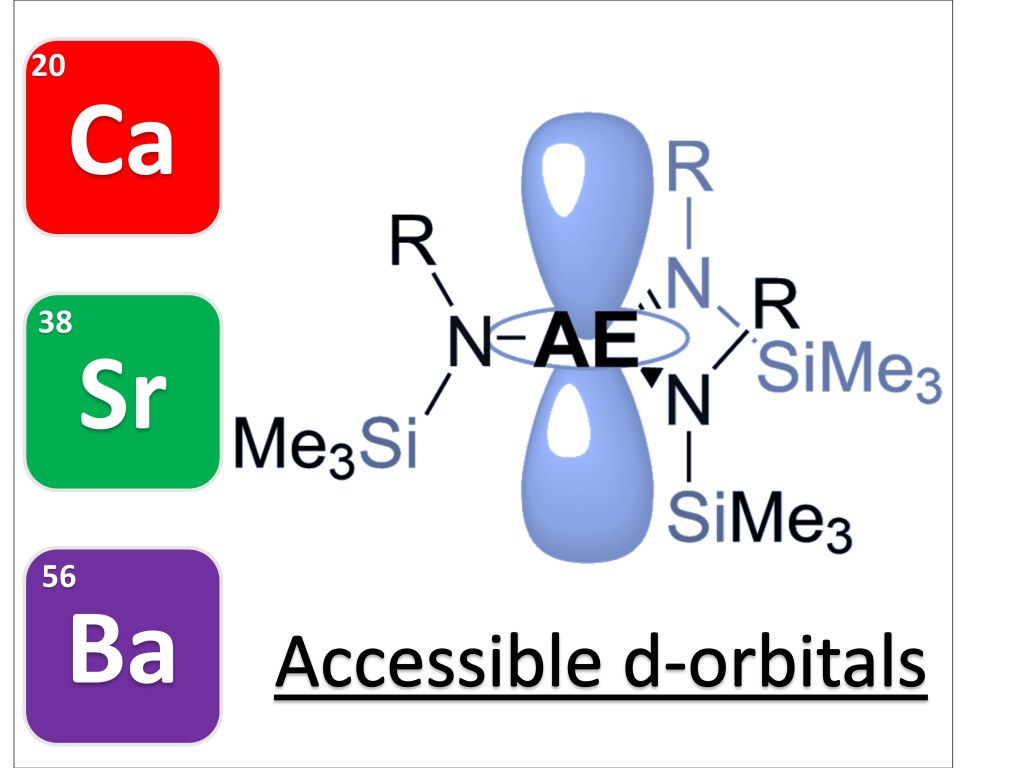
In the Ortu Group we are focussing on new methodologies to isolate elusive heavy Group 2 (Ca-Ba) complexes in the +1 oxidation state, in which the oxidation state of the metal isn’t supported by the presence of metal-metal bonds. We are focusing, in particular, on the involvement of d-orbitals for the stabilisation of these targets (read here).
Selected publications:
- Heavy Alkaline Earth Cyclic (Alkyl)(Amino)Carbene Complexes Supported by Aryl-silyl Amides: A.W.J. Bowles, Y. Liu, M.P. Stevens, F. Ortu, Inorg. Chem., 2024, 29, 5757, DOI:10.1021/acs.inorgchem.4c03494.
- A Blueprint for the Stabilization of Sub-Valent Alkaline Earth Complexes: A.J.W. Bowles, Y. Liu, M.P. Stevens, I.J. Vitorica-Yrezabal, C.L. McMullin, F. Ortu, Chem. Eur. J., 2023, 29, e202307850, DOI: 10.1002/chem.202301850.
Fundamental alkaline earth and rare earth organometallic chemistry
Organometallic chemistry of the group 2 metals and rare earth elements has a widespread utility. These are particularly beneficial for improving the sustainability of chemical manufacturing, as both classes of metals are, in general, earth abundant and non-toxic (learn more about the applications of alkaline earth metals here and here, together with a comprehensive review on rare earth synthetic chemistry from our team here).

In the Ortu Group we are interested in developing new reactions and methodologies to expand the organometallic chemistry of these fascinating metals, using ligand design and a suite of physical characterisations, collaborating with computational chemists and spectroscopists to study reaction mechanisms and key physical properties.
Selected publications:
- Synthesis, Characterisation and Reactivity of Group 2 Complexes with a Thiopyridyl Scorpionate Ligand: M.P. Stevens, E. Spray, I.J. Vitorica-Yrezabal, K. Singh, V.M. Timmermann, L. Sotorrios, S.A. Macgregor, F. Ortu, Dalton Trans., 2022, 51, 11922, DOI: 10.1039/D2DT02012B.
- Synthesis, characterization and reactivity of a series of alkaline earth and rare earth iminophosphoranomethanide complexes: M.P. Stevens, Y. Liu, E. Alexopoulos, S.S.A. Xec Daudo, A. Khan, R.R. Hawker, L. Lezama, D. Reta, F. Ortu, Commun. Chem., 2025, 8, 175, DOI: 10.1038/s42004-025-01572-5.
Actinide and nuclear chemistry
Our team works on the development of new methods and materials applicable to the nuclear sector. We have a particular interest in the development of new separation strategies to extract valuable materials from nuclear waste streams, together with the fabrication of new nuclear fuels and materials. We also collaborate closely with teams at Space Park Leicester working on the development of Radioisotope Power Systems (RPS) for Earth and space exploration (read more about it here), offering advice on various aspects of nuclear chemistry.
Current active PhD projects in the Group
- Frustrated Lewis Pairs in Rare Earth Chemistry
- New chemical tools for actinide-lanthanide separation – collaboration with Dr Emily Jane Watkinson and Space Park Leicester
- Lanthanide-based anti-breast cancer stem cell agents – collaboration with Dr Rama Suntharalingam
Collaborators
Dr Rama Suntharalingam (University of Leicester)
Dr Emily Jane Watkinson (University of Leicester, Space Park Leicester)
Prof. Richard Ambrosi (University of Leicester, Space Park Leicester)
Prof. Stuart A. Macgregor (Heriot-Watt University, UK)
Dr Erli Lu (University of Birmingham, UK)
Dr Claire McMullin (University of Bath, UK)
Dr Daniel Reta (University of the Basque Country – UPV/EHU, Spain)
Prof. Henry La Pierre (Georgia Tech, USA)
Dr James Dawson (Newcastle University, UK)
Prof. Antonio Zucca (Università degli Studi di Sassari, Italy)
Prof. Sergio Stoccoro (Università degli Studi di Sassari, Italy)
Dr Floriana Tuna (University of Manchester, UK)
Prof. David Collison (University of Manchester, UK)
 Ortu Research